In the modern conditions of Ukrainian business, the issue of stable power supply has moved from the category of “desired options” to the category of critical survival factors. The experience of previous winters has clearly shown enterprises that any power supply interruptions lead to a stoppage of production, spoilage of raw materials, termination of contracts and additional losses.
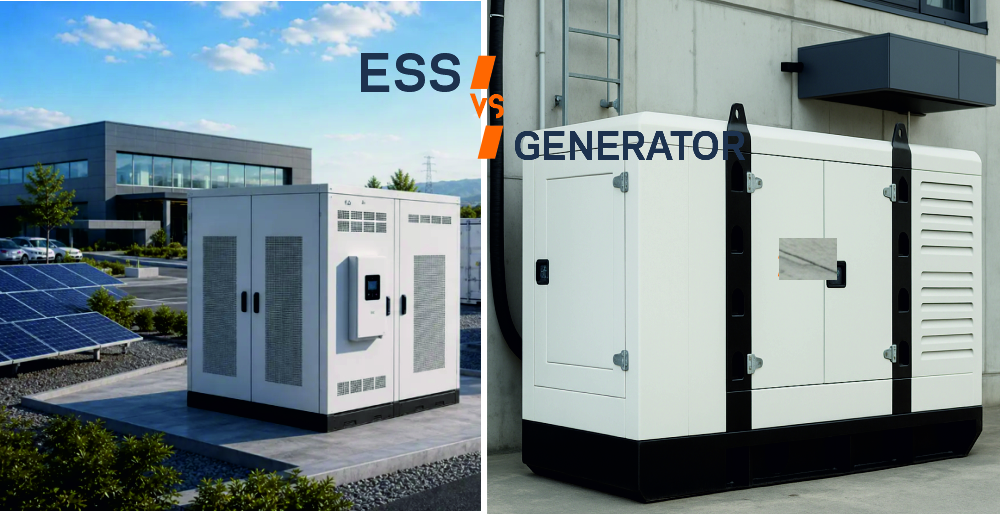
When there is a need to protect the enterprise from blackouts, managers usually choose between two solutions: a conventional diesel (or gasoline) generator and a modern energy storage system (ESS). Which one to give preference to? Let's understand from the point of view of economy, reliability and efficiency.
What is a generator and why is it losing its relevance
Diesel and gasoline generators have been a classic backup power source for years. Their main advantage is the relatively low initial cost of equipment and ease of use.
However, during long power outages, the “classic” demonstrates a number of critical DISADVANTAGES for business:
High total cost of ownership (TCO)
Requires constant transportation and storage of significant amounts of fuel, and the price of fuel is constantly increasing. In addition, the generator requires constant maintenance, replacement of oils, filters, and regular overhaul during intensive cycling.
Limited resource and ecology
Noise, vibration, harmful carbon dioxide emissions into the atmosphere, and rapid engine wear when operating 24/7.
Does not save from instant power outage
By the time the engine starts up, sensitive equipment will have already had time to “fall”, disrupting the entire technological cycle.
ESS (Energy Storage System / ESS): an innovative approach for business
ESS (Energy Storage System) or industrial battery (based on modern lithium-iron-phosphate LiFePO4 cells) is a completely different level of technology. In combination with a solar power plant (SPP) and an intelligent energy management system (EMS), ESS becomes the "brain" and buffer of the enterprise's energy independence.
The main ADVANTAGES of ESS over a generator:
Instant switching
When the external network disappears, the system transfers the load to the reserve in milliseconds - the equipment (servers, machines, sensitive electronics) will not even notice the switching, unlike when a generator is started.
Energy arbitrage and savings
UZE allows you to accumulate electricity at night at minimal tariffs (or from excess own solar generation during the day) and use it during peak load hours, when the price of electricity from the network is maximum.
Complete autonomy and silence
No emissions, noise or vibration. UZE can be installed indoors or in compact modular containers next to the object.
Durability
The resource of high-quality industrial batteries is 6000–8000 cycles, which guarantees 10–15 years of stable operation without the need for constant intervention.
Direct comparison: UZE vs Generator
| Comparison criterion | Diesel/Gasoline generator | UZE (Energy storage system) |
|---|---|---|
| Initial investment | Low | Higher (but quickly pays off) |
| Operating costs | Very high (constant fuel purchase) | Minimal (using grid or solar power) |
| Response speed | Slow (seconds to minutes to start) | Instant (UPS-format uninterruptible power supply) |
| Environmental friendliness and noise | Noisy, exhaust gases, harmful emissions | Silent, environmentally safe |
| Energy management | None (works only as an emergency reserve) | Integration with SES, EMS and energy arbitration function |
| Service life | Limited by engine life | 10+ years of active cycling |
. Our experience shows that considering a generator as the only savior from blackouts is the path to constant cash gaps due to the price of fuel.
UZE in conjunction with a solar power plant transforms the energy complex of an enterprise from a "passive expense item" into a powerful tool for optimizing the cost of production. By reducing energy dependence on external markets, the company gains a competitive advantage in the market.
Of course, in some specific remote locations without mains power, a generator can be used as a temporary auxiliary element, but for a stable commercial or industrial facility in a city or industrial zone, it is UZE SES that is the gold standard of reliability.
Conclusion: what to choose for your business
If you are looking to temporarily "survive" an accident on basic lighting and are ready to spend money on fuel every day - a generator remains the cheapest solution at the starting stage.
But if your goal is to build a sustainable, energy-efficient business for an energy company that is not afraid of either tariff increases or long-term grid outages, an investment in a modern energy storage system (ESS) and solar generation will pay off most quickly thanks to fuel savings, no downtime, and the opportunity to earn on energy arbitrage.