The energy crisis and tariff spikes have shifted the priorities of Ukrainian businesses. Seeking to protect production from blackouts and reduce product costs, the commercial sector has begun building its own generation capacity on a large scale. Enterprises are installing rooftop solar power plants, purchasing industrial energy storage systems (ESS), and connecting diesel or gas-piston generators.
However, in practice, many business owners and C-level executives encounter an unexpected problem: simply owning expensive energy assets does not guarantee maximum savings.
If a solar plant, an industrial energy storage system, and the grid connection operate haphazardly—each following its own basic settings—the company loses out on hundreds of thousands of hryvnias every month. Solar energy is wasted or fed into the grid for a pittance, the battery charges during peak hours at the highest tariff rate, and the diesel generator kicks in when backup power would have sufficed.
To transform disparate equipment into a single, highly profitable system, a business needs "brains"—an EMS.
What is an EMS?
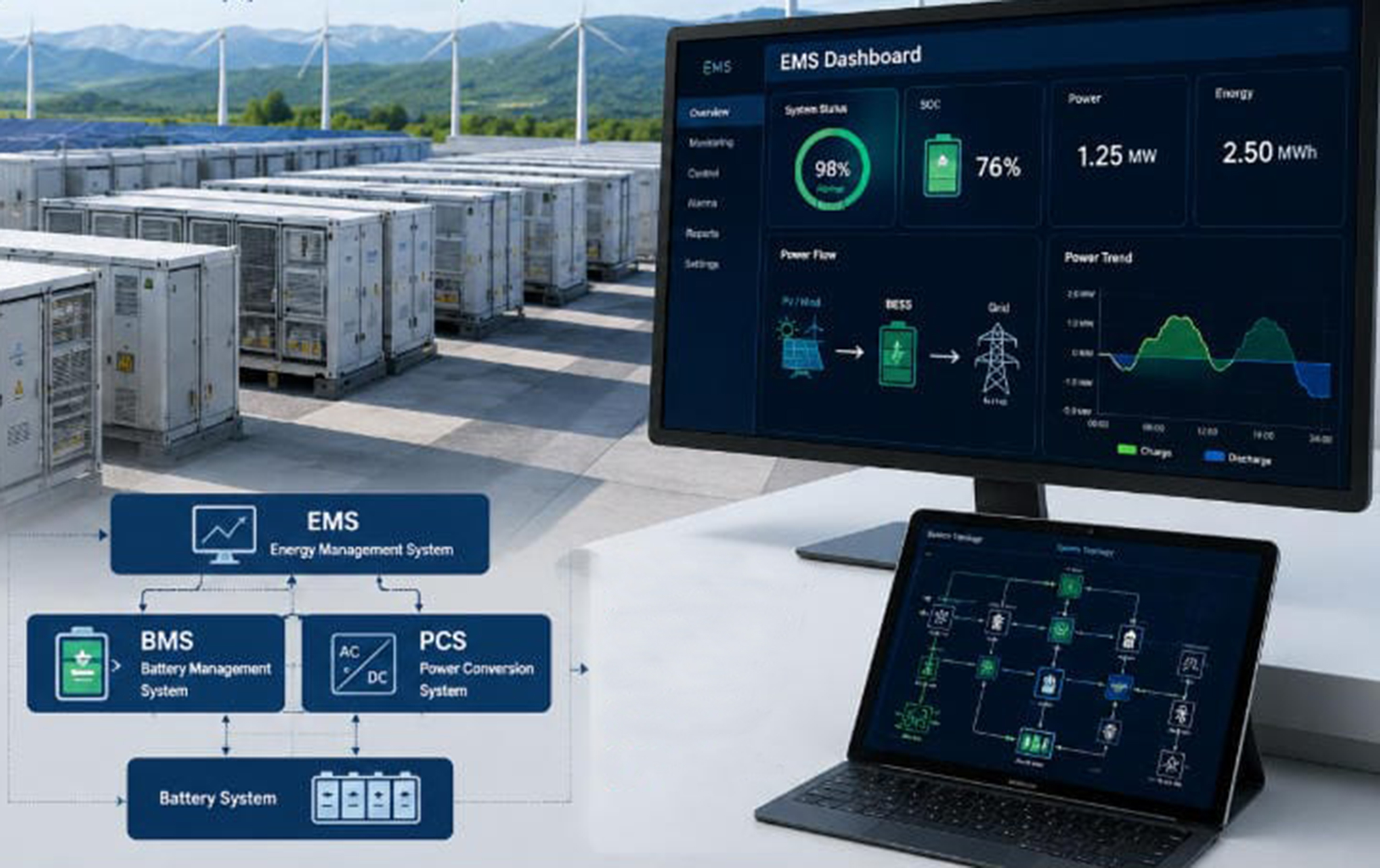
An EMS (Energy Management System) is an intelligent hardware-and-software solution that monitors an enterprise's electricity consumption in real time, analyzes tariff structures, forecasts generation and consumption, and automatically manages all of the company's energy assets.
If the solar panel is the "heart" and the energy storage system (ESS) is the "muscles" of your energy system, then the EMS is its "brain." ## Why is an EMS needed?
When a facility has more than one energy source or consumer—for example, an industrial solar power plant, the grid, and an industrial energy storage system—a complex, multi-level challenge arises:
- When is it most cost-effective to consume self-generated solar energy?
- When should the battery be charged?
- At what times is it advisable to discharge the storage system to avoid expensive peak tariffs?
- When should electricity be purchased from the grid, and when should surpluses be sold?
A human cannot analyze dozens of parameters and manually switch operating modes every second. An EMS performs this automatically, eliminating the human factor and calculating the most profitable operating algorithms 24/7.
Architecture and 3 Levels of an Energy Management System
A modern energy storage and generation system managed by an EMS features a clear three-level structure:
+-----------------------------------------------------------------------+
| 1. INTERFACE LEVEL (User Interface / Web & Mobile)                    |
| Real-time visualization of P&L, generation, ESS charge, and savings   |
+-----------------------------------------------------------------------+
▲
│ (Data / Commands)
▼
+-----------------------------------------------------------------------+
| 2. ANALYTICAL LEVEL ("Brain" / Core Analytics)                        |
| AI algorithms, DAM/BM tariff analysis, forecasting                    |
+-----------------------------------------------------------------------+
▲
│ (Modbus, CAN, IEC protocols)
▼
+-----------------------------------------------------------------------+
| 3. EQUIPMENT CONTROL LEVEL (Control Hardware)                         |
| Automated commands: Solar PV plants, ESS, inverters, generators       |
+-----------------------------------------------------------------------+
Level 1. User Interface
A dashboard for top management, the chief power engineer, and the CFO, providing visibility via a web platform or mobile app regarding:
- The enterprise's current consumption profile.
- Solar power plant generation output.
- Energy Storage System (ESS) state of charge (SoC).
- Actual financial impact and cost savings (in UAH or EUR) for a selected period.
Level 2. "Brain" and Mathematical Core (Core & Analytics)
A central controller and a cloud/local server where data arrays are processed. Algorithms make decisions based on:
- Weather forecasts (to estimate solar generation).
- The enterprise's production line operating schedules.
- Price fluctuations in the Day-Ahead Market (DAM) and the Balancing Market (BM).
Level 3. Equipment Connectivity (Control & Hardware Layer)
This is the execution layer. The EMS controller sends direct command signals to solar inverters, ESS controllers, switchgear, and diesel generators, instantly switching between operational scenarios.
Basic EMS and ESS operational scenarios for an enterprise
To understand how the energy storage system and solar PV plant work in conjunction with the EMS, let us consider a practical example involving a typical manufacturing plant, logistics complex, or retail facility.| Time of Day | System Status (No EMS) | EMS Operation Scenario | Economic Impact | | --- | --- | --- | --- | | Night (00:00 – 07:00) | Grid consumption at the standard night tariff. Batteries remain idle. | Storage Charging: The EMS commands the ESS to charge to 100% from the grid during off-peak hours (lowest electricity cost). | Purchasing energy at the lowest daily rate. | | Day (08:00 – 16:00) | Solar plant generates energy. If generation exceeds consumption, solar energy is wasted or curtailed by the inverter. | Self-Consumption Optimization: The solar plant powers the facility. The EMS directs surplus solar energy to top up the BESS. | Zero feed-in (no uncompensated export to the grid); 100% utilization of self-generated solar power. | | Evening Peak (17:00 – 23:00) | Solar plant is inactive. The facility draws power from the grid during the most expensive hours of the day. | Peak Shaving & Arbitrage: The EMS cuts off grid consumption and switches the facility to power supplied by the energy storage system. | Peak shaving; savings of up to 70–80% on evening tariff costs. |
Key EMS Capabilities for Commercial Facilities
Peak Load Shaving
Every enterprise has a permitted grid connection capacity allocated by the Distribution System Operator (DSO). Exceeding these limits risks massive fines or disconnection. When heavy equipment (such as compressors, furnaces, or refrigeration units) starts up simultaneously at a plant, a brief consumption spike occurs. The EMS instantly detects this surge and engages the industrial energy storage system, covering the spike using battery power without drawing additional capacity from the grid.
Energy Arbitrage
Electricity arbitrage is a strategy involving the purchase of energy when prices are low and its subsequent use or sale during peak-price hours. The EMS automatically monitors hourly prices on the Day-Ahead Market (DAM):
- Purchases and stores low-cost energy at night.
- Powers the facility using the BESS during daytime and evening peak tariff periods.
- Sells surplus stored energy back to the grid at the highest rates (where permitted).
Backup Power and Business Continuity
In the event of an external grid failure or blackout, the EMS-managed energy storage system switches critical infrastructure to backup power within milliseconds—without interrupting the production process. This protects expensive machinery, server rooms, and production lines from malfunctions and product defects.
Financial Benefits and Payback
For C-level executives, the key criteria for any investment are ROI, NPV, and EBITDA protection.
┌────────────────────────────────────────────────────────────────────────┐
│                        ECONOMIC IMPACT OF EMS                          │
├────────────────────────────────┬───────────────────────────────────────┤
│ Direct reduction in            │ Reduction in electricity bills        │
│ electricity costs              │ by up to 70% or more                  │
├────────────────────────────────┼───────────────────────────────────────┤
│ Investment payback period      │ Reduction from 10+ years              │
│ (ROI)                          │ to 2.5–4 years                        │
├────────────────────────────────┼───────────────────────────────────────┤
│ Reduction in production        │ Decrease in the energy component      │
│ costs                          │ of production costs by 40–50%         │
└────────────────────────────────┴───────────────────────────────────────┘
Financial benefits of implementing EMS + ESS
-
Reduction in operating expenses (OPEX) By optimizing the operating modes of solar power plants and energy storage systems, the enterprise reduces annual electricity costs by up to 70%.
-
Drastic reduction in payback periods Just a few years ago, the payback period for industrial energy storage systems exceeded 10 years. Thanks to smart management via EMS, integration with solar generation, and rising tariffs, the project payback period has been reduced to 2.5–4 years.
-
Protection of margins and EBITDA The energy component in the cost structure of Ukrainian goods and services sometimes ranges from 15% to 40%. Locking in the cost per kilowatt-hour through an on-site commercial solar power plant and BESS enables the forecasting of financial results years in advance. 4. Fuel savings for generators Instead of burning expensive diesel during hours-long grid outages, the EMS powers the facility using batteries; the cost per cycle for these is a fraction of that of diesel generation.
The future of energy: EMS and Virtual Power Plants (VPP)
The development of energy management systems opens up a whole new level of opportunity for Ukrainian enterprises: the creation of Virtual Power Plants (VPPs). A VPP integrates dozens or hundreds of distributed energy assets—such as solar power plants (SPPs), energy storage systems (ESS), and diesel generators from various companies—into a unified network managed by a cloud-based EMS.
The enterprise ceases to be merely a consumer and becomes a full-fledged participant in the energy market (acting as both producer and consumer). The company can prov...provide power system balancing services to Ukrenergo, sell ancillary services, and generate stable, additional passive income.
7. Why implement a project with ETL Group?
Building an efficient energy supply system for an enterprise requires deep engineering expertise, professional load profile analysis, and flawless installation.
ETL Group is a leading EPC contractor in Ukraine with over 15 years of experience in the renewable energy sector. We provide a full cycle of turnkey services:
- In-depth engineering and feasibility studies. Free development of a feasibility study featuring an hourly simulation of the PV + BESS + EMS system tailored to your consumption schedule.
- Tier 1 equipment. Use of exclusively certified inverters, solar panels, and battery cells from global industry leaders.
- In-house manufacturing. Design and assembly of electrical switchgear and automation systems.
- Full EPC cycle. From project development and obtaining grid connection specifications to commissioning and 24/7 service monitoring (O&M).
Frequently Asked Questions (FAQ)
What is EMS in the energy sector?
EMS (Energy Management System) is an intelligent system for managing an enterprise's energy resources; it automatically optimizes the operation of solar power plants, energy storage systems (BESS), generators, and the grid to minimize electricity costs.
How does EMS differ from BMS?
The BMS (Battery Management System) is responsible for the safety and physical condition of the battery itself (monitoring voltage and temperature, and balancing cells). The EMS operates at a higher level, managing the facility's entire energy system and determining exactly when and how to utilize the energy storage unit to maximize financial returns.
What is the payback period for an ESS + EMS system for a business?
Thanks to peak shaving and energy arbitrage, the average payback period for an industrial energy storage system managed by an EMS in Ukraine ranges from 2.5 to 4 years.
Can an EMS be installed on an existing solar power plant (SPP)?
Yes, the EMS is a versatile solution. It integrates easily with existing rooftop or ground-mounted solar power plants, incorporating industrial energy storage units and automating energy consumption processes.