The Ukrainian energy market is changing rapidly. If a few years ago, companies considered electricity exclusively as an expense item, today it is increasingly becoming a separate business asset that can bring additional income.
One of the most promising areas is electricity arbitrage - a strategy that allows you to make a profit due to the difference in prices in different market segments. It works most effectively in combination with energy storage systems (BESS) and your own generation.
What is electricity arbitrage?
Electricity arbitrage is making a profit due to the difference in the cost of electricity at different times of the day or in different market segments.
The principle is quite simple:
electricity is purchased or stored when it costs less;
is used or sold when its price is maximum.
To implement this model, companies use energy storage systems (ESS), which are charged during hours of low prices and give electricity during hours of peak demand.
That is why today the concept of energy arbitrage has become one of the main drivers of the development of commercial energy storage systems.
What is the DAM and BR market?
The greatest opportunities for arbitrage are opened by:
Day-ahead market (DAB)
In this segment, participants buy and sell electricity for the next day. It is here that the hourly price of electricity is formed depending on demand, generation, weather conditions, seasonality, and load on the power system.
At different times of the day, the difference in cost can be very significant.
Balancing market (BR)
The balancing market is used to maintain the stability of the power system in real time. If there is a shortage of electricity in the system, the operator purchases it at a higher price. That is why market participants who have fast-acting energy storage units (FSU) can provide ancillary services and receive additional income.
How does energy arbitrage work?
Let's consider a simplified example.
- At night, the price of electricity is minimal. The company charges the energy storage system.
- During the daytime or evening peak, when the cost of electricity increases significantly, the stored energy is used for its own production or sold in the appropriate market segment.
Thus, the business actually replaces expensive electricity with cheap electricity or receives income from the price difference.
Why does the SPP + ESS model work best?
The maximum economic effect is provided by the combination of:
solar power plant (SPP) + energy storage systems (ESS) + digital management system (EMS)
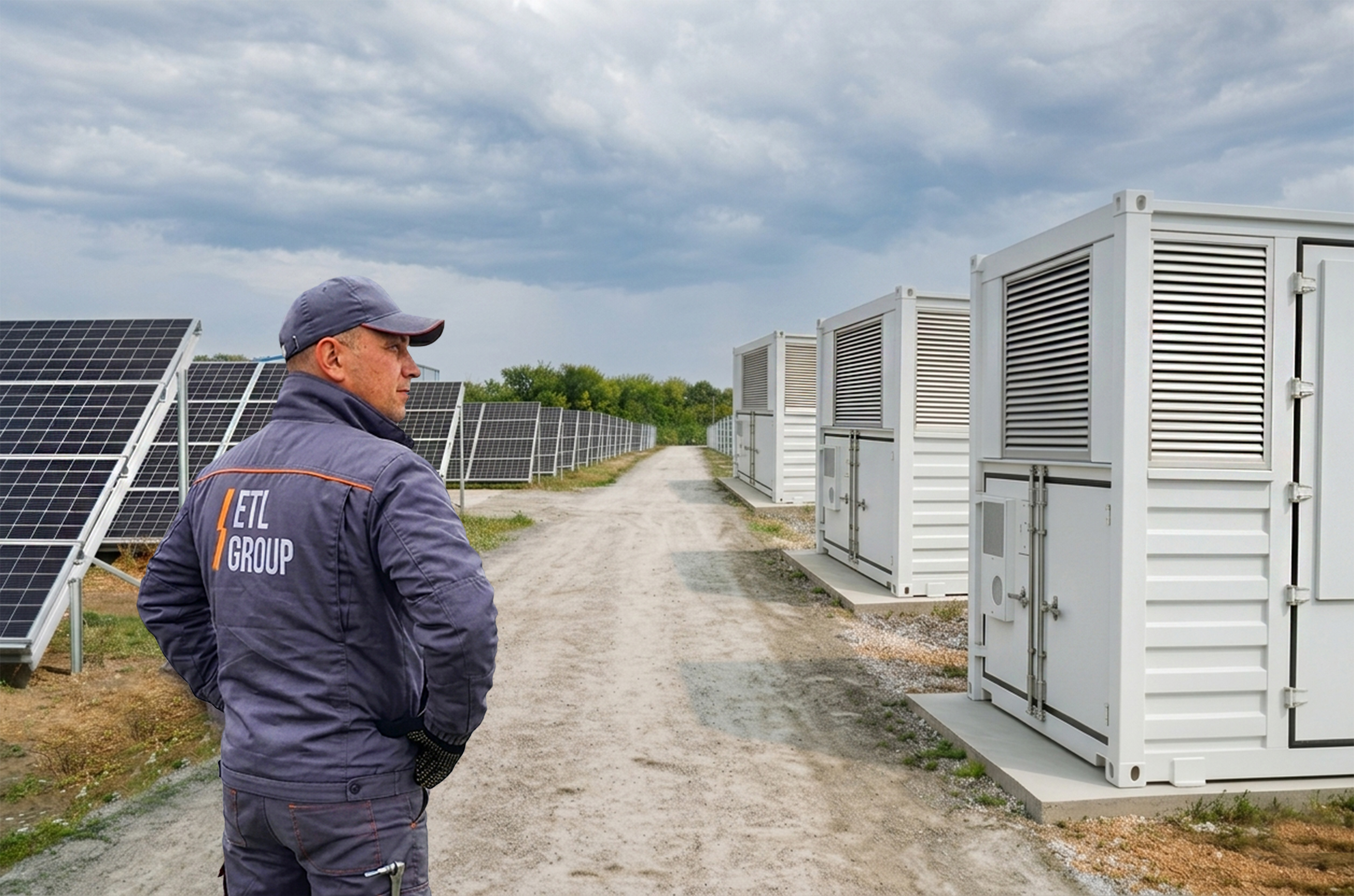
In this configuration, during the day, a solar power plant for a business generates electricity, part of the generation is immediately used by the enterprise, and the surplus is not lost and is accumulated in the ESS.
Next, the system automatically determines the most profitable scenario:
-
to ensure its own consumption;
-
to avoid an expensive tariff;
-
or to sell electricity at a more favorable price.
In fact, the enterprise begins to manage energy as a financial asset.
What benefits does the business receive?
Additional profit
Energy arbitrage opens up a new source of income without expanding the main production. An asset that previously only provided electricity supply begins to work for the enterprise's profitability.
Lower electricity costs
The enterprise minimizes the purchase of electricity during the hours of the highest tariffs. As a result, the average cost of electricity can be significantly reduced.
Faster return on investment
While previously the payback of a solar power plant depended mainly on electricity savings, today ESS adds another financial instrument, namely the ability to earn on the electricity market. That is why modern SPP + ESS projects demonstrate a higher ROI than classic solar power plants.
Protection against price fluctuations
The company is less dependent on market jumps in the cost of electricity, seasonal fluctuations, peak tariffs, and instability of the power system. This makes costs more predictable.
Higher energy stability
The energy storage system can be used not only for arbitrage. It also provides backup power, support for critical equipment, protection against emergency shutdowns, and reduction of the risk of production downtime.
Which enterprises benefit most from arbitrage?
The greatest potential is for companies that consume more than 300–500 MWh of electricity per year, work in multiple shifts, have significant evening loads, already use a solar power plant or plan to install an energy storage system, and seek to increase energy independence and reduce operating costs.
Such solutions are especially relevant for manufacturing enterprises, logistics complexes, agro-processing, the food industry, shopping and entertainment centers, warehouses, and municipal infrastructure.
How does ETL Group help implement energy arbitrage?
Before launching a project, the company's engineers analyze the enterprise's consumption profile, hourly load, generation potential, tariff model and scenarios of operation in the DAM/BR market. This allows you to form an individual energy strategy that ensures maximum economic effect.
ETL Group acts as an EPC contractor and implements complex projects for businesses:
- design of solar power plants;
- turnkey construction of solar power plants;
- BESS integration;
- implementation of energy management systems;
- equipment selection;
- calculation of the economic model;
- payback and ROI modeling;
- service.
Electricity arbitrage is no longer a tool only for large energy companies. Thanks to the development of energy storage systems (ESS), digital management platforms and the RDN/BR market, it is becoming available to industrial enterprises and the commercial sector. The combination of a solar power plant, ESS and intelligent energy management allows not only to reduce electricity costs, but also to create a new source of income, increase the return on investment and ensure long-term energy sustainability of the business.